If you’ve ever stood in the sunscreen aisle squinting at ingredient lists while your toddler unravels a display rack, you already know the problem: there are dozens of products, the labels all say “kids” or “gentle,” and none of them explain what’s actually different. Here’s the short version before we get into the details. Sunscreens come in two basic types — mineral (which uses zinc oxide or titanium dioxide to physically block UV rays) and chemical (which uses synthetic compounds like oxybenzone or avobenzone to absorb UV rays and convert them to heat). For babies and young children, most dermatologists and pediatricians recommend mineral formulas because they sit on top of skin rather than absorbing into it, and because they don’t contain the active chemical filters that have raised questions about hormonal disruption. SPF 50 means the sunscreen blocks roughly 98% of UVB rays — the ones responsible for sunburn. This guide will walk you through what matters most when picking a mineral SPF 50 for your kids, flag the trade-offs that actually affect daily use, and help you make a confident call without needing a chemistry degree.
| EDITOR'S PICK[Banana Boat 100% Mineral Kids S…](https://www.amazon.com/dp/B084R1RWM1?tag=greenflower20-20) | Mid-tier[Blue Lizard BABY Mineral Sunscr…](https://www.amazon.com/dp/B0862PNNLG?tag=greenflower20-20) | Budget pick[Thinkbaby SPF 50+ Baby Sunscreen](https://www.amazon.com/dp/B004CDQ73K?tag=greenflower20-20) | |
|---|---|---|---|
| SPF Rating | 50 | 50+ | 50+ |
| Size | 6 Fl Oz | 5 oz. | 3 Oz. |
| Water Resistant | — | ✓ | ✓ |
| Pack Count | 2 | 1 | 1 |
| Fragrance Free | — | ✓ | — |
| Price | $28.98 | $14.94 | $11.19 |
| See on Amazon → | See on Amazon → | See on Amazon → |
Why “Mineral Only” Is the Practical Default for Young Skin — Not Just a Marketing Line
The American Academy of Dermatology Association’s Sunscreen FAQs and the Skin Cancer Foundation’s guidance both point to the same logic: infant and toddler skin is thinner, more permeable, and covers more body-surface-area relative to bodyweight than adult skin. That’s not a reason to panic — it’s a reason to be intentional about what you’re applying several times a day.
The FDA’s 2019 proposed sunscreen monograph (updated and ongoing as of 2026) flagged zinc oxide and titanium dioxide as “generally recognized as safe and effective” (GRASE), while it simultaneously called for more data on 12 chemical UV filters including oxybenzone and octinoxate. The FDA hasn’t banned those chemical filters, but it hasn’t fully cleared them either. For parents who are making a “precautionary principle” call — and most informed ones are — mineral-only is the rational default while the regulatory picture sorts itself out.
The practical trade-off you’re actually managing: Mineral sunscreens leave a white cast. Zinc oxide, especially at concentrations of 20–25% (which you need for robust SPF 50 coverage), does not blend invisibly on any skin tone. Brands address this in three ways:
- Micronized zinc — smaller particles that blend better but have raised some low-level inhalation concern in sprays (not a concern in lotions).
- Tinted formulas — offset the white cast with iron oxides; also add visible-light protection, which is a genuine bonus.
- Elegant emollient bases — thicker, creamier formulas that spread more sheer with proper buffing.
None of these fully eliminate the cast on deeper skin tones. This is an honest limitation of the category, not a formulation failure.
The Numbers That Actually Matter Before You Buy
By the numbers:
| What the label says | What it means in practice |
|---|---|
| SPF 30 | Blocks ~96.7% of UVB rays |
| SPF 50 | Blocks ~98% of UVB rays |
| SPF 50+ / PA+++ | SPF 50 UVB + rated UVA protection (PA system, common on Japanese/Korean imports) |
| Broad-spectrum | Protects against both UVB (burn) and UVA (aging, deeper damage) — required on all U.S. sunscreens per FDA rule |
| Water-resistant (80 min) | Maintains labeled SPF after 80 minutes of water exposure; the maximum allowed claim under FDA rules |
The jump from SPF 30 to SPF 50 is real but modest in percentage terms — about 1.3 additional percentage points of UVB blocked. Where SPF 50 earns its place for kids: it creates a meaningful safety buffer when application is imperfect (which it always is on a squirming four-year-old). The Environmental Working Group’s annual sunscreen guide consistently notes that real-world protection is lower than lab-rated SPF because people apply too little and don’t reapply often enough. SPF 50 gives you a wider margin for those inevitable misses.
How to Read a Mineral Sunscreen Label for Kids: The Four Things That Matter
Once you’re past “mineral only” and “SPF 50 broad-spectrum,” four additional factors separate a sunscreen you’ll actually use consistently from one that collects dust.
1. Zinc Oxide Concentration (and Whether Titanium Dioxide Is Added)
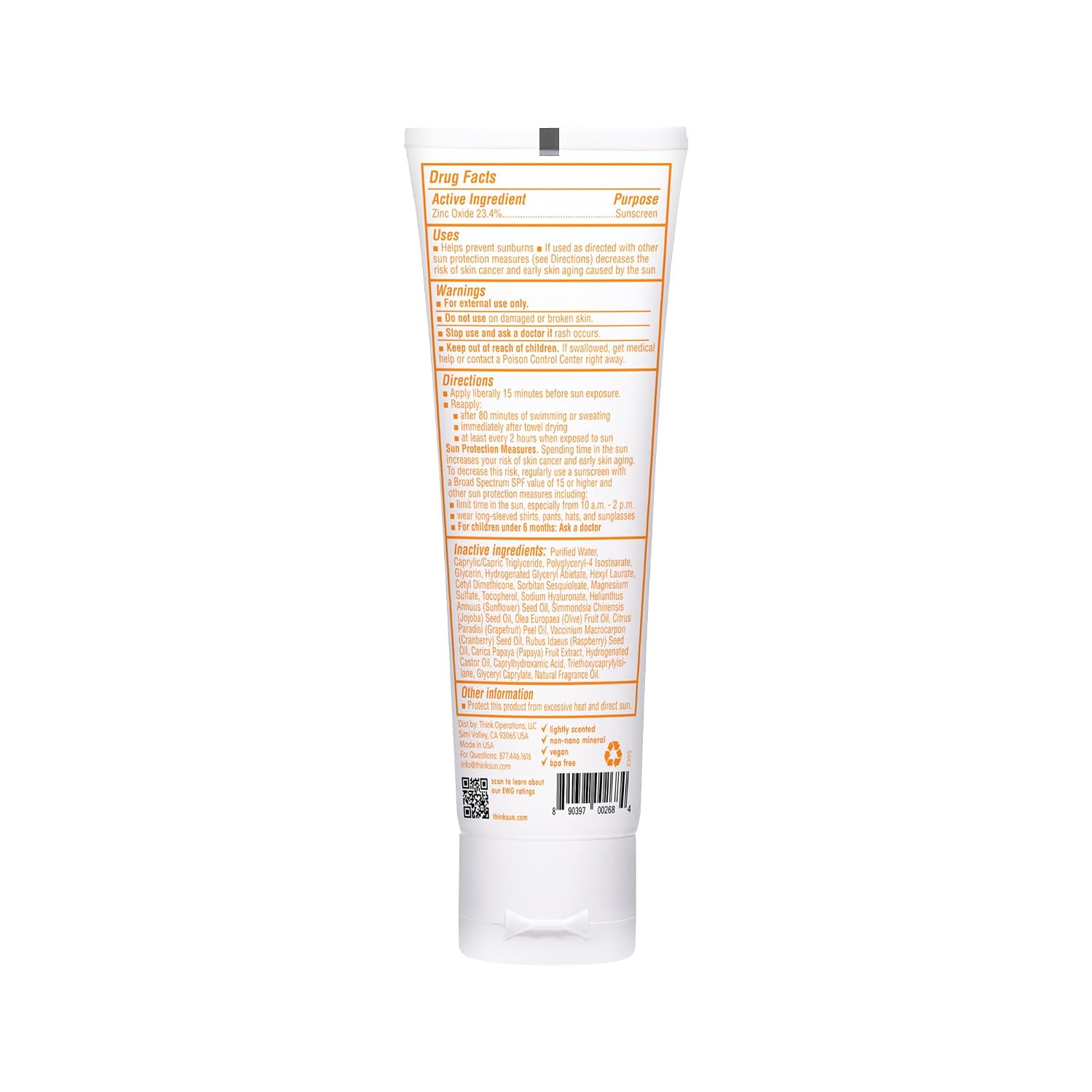
Look for zinc oxide at 18–25% as the primary active. That range is where you get reliable SPF 50 coverage in a mineral-only formula. Some brands combine zinc oxide with titanium dioxide to hit SPF 50 at a lower zinc percentage — that’s fine and often improves texture. What to avoid: products that list zinc oxide at 10–12% and pad SPF 50 with chemical filters under the label “mineral blend.” That’s a mixed formula, not a pure mineral one.
2. Fragrance and Sensitizer Load
Kids’ skin reacts to fragrance more readily than adults’. The American Academy of Pediatrics guidance on sun safety emphasizes fragrance-free formulas for children under 2, and most dermatologists extend that recommendation to school-age kids with eczema-prone or reactive skin. Scan the inactive ingredients for: fragrance, parfum, essential oils (lavender and citrus in particular can be photosensitizers), methylisothiazolinone (MI), and formaldehyde-releasing preservatives. A clean inactive list is a genuine differentiator, not a premium-brand luxury.
3. Reef-Safe Compliance
Hawaii’s Act 104 (effective January 1, 2021) and subsequent legislation in Key West and Palau have banned oxybenzone and octinoxate. A mineral-only SPF 50 formula is inherently reef-safe under those frameworks — zinc oxide and titanium dioxide are not on any current restricted list. If you’re traveling to a protected marine area or simply care about the ecosystems your kids are swimming in, this matters. Worth noting: “reef-safe” is not an FDA-regulated claim, so any chemical sunscreen can technically print it on the label. Pure mineral formulas are the only ones that genuinely qualify under existing legislation.
4. Water Resistance Rating
For children, “water-resistant (80 minutes)” is the only worthwhile rating. The FDA permits two claims: 40-minute and 80-minute water resistance. For any beach, pool, or sprinkler-park scenario, 40 minutes is simply not enough runway. Reapplication is still required after 80 minutes — that’s non-negotiable — but the 80-minute rating gives you a realistic buffer for actual kid behavior.
The Age-Specific Decision Fork: Babies Under 6 Months vs. Kids 6 Months and Up
This distinction matters because the guidance diverges sharply.
Under 6 months: The Skin Cancer Foundation and American Academy of Pediatrics both recommend keeping infants out of direct sun entirely and prioritizing shade, protective clothing (UPF 50+ infant suits and hats), and timing outdoor exposure to avoid the 10 a.m.–4 p.m. UV peak. Sunscreen is a last resort for this age group, not a first line of defense. If sun exposure is unavoidable, a small amount of mineral SPF 30–50 on exposed areas (face, hands) is considered acceptable — but shade and UPF fabric should do the heavy lifting.
6 months and up: Full-body mineral SPF 50 is appropriate and encouraged for any meaningful outdoor exposure. The AAD recommends 1 ounce (about a shot glass) for the full body, applied 15 minutes before going outside. For kids, that 15-minute lead time is worth building into your routine — zinc oxide takes a moment to form a coherent layer.
Tradeoffs Between Budget and Premium Picks — Named Explicitly
Across aggregated reviews and published formulation comparisons, the mineral kids’ sunscreen market in 2026 broadly splits into three tiers:
Budget tier ($8–$15): Brands like Coppertone Pure & Simple Kids and Banana Boat Simply Protect Kids use zinc oxide plus titanium dioxide combinations in the 18–20% active range. Reviewers consistently note acceptable texture for price. The white cast is more pronounced, and some formulas use fragrance. For families applying sunscreen daily to multiple children, this is a defensible choice if you verify fragrance-free and water-resistant 80 min on the label.
Mid-tier ($16–$28): This is where the parent community’s strongest consensus tends to land. Products like Thinkbaby Safe Sunscreen SPF 50+, Blue Lizard Baby Mineral Sunscreen SPF 50+, and Badger Baby Sunscreen Cream SPF 40 (note: Badger’s SPF 40 is the current flagship; their SPF 30+ for kids is widely reviewed) get consistently high marks in EWG’s annual sunscreen guide for clean ingredient lists and zinc-forward formulations. Thinkbaby and Blue Lizard in particular appear year after year in EWG’s top-rated lists, with Blue Lizard earning recognition for its UV-reactive lid that changes color in sunlight — a legitimately useful feature for parents who forget whether they’ve stepped outside.
Premium tier ($30–$45): CeraVe Hydrating Mineral Sunscreen SPF 50 (not kids-specific, but widely recommended by dermatologists for sensitive pediatric skin) and California Baby Super Sensitive SPF 30+ (fragrance-free, botanical-based) serve parents who prioritize dermatologist-aligned formulas with skin-barrier support. Byrdie and Allure reviewers both note that CeraVe’s inclusion of ceramides and hyaluronic acid makes it a useful daily option for eczema-prone kids — it functions as moisturizer and sun protection in one step.
The honest math: A 3-ounce tube at $20, applied at the recommended 1-ounce per full-body application, lasts three full applications. For a beach week with two kids, budget 4–6 tubes minimum. At mid-tier prices, that’s $80–$120 in sunscreen for one week. This is the real reason parents sometimes under-apply — the perceived cost per application creates unconscious rationing. Buying in multipacks or 6-ounce formats when a formula works for your family changes the economics meaningfully.
The “If X, Then Y” Decision Rules
You don’t need to memorize everything above. Here’s the decision tree that covers most families:
- If your child is under 6 months → prioritize UPF 50+ clothing, shade, and timing. Use mineral sunscreen only on unavoidably exposed areas.
- If you want the cleanest possible ingredient list on a budget → Thinkbaby SPF 50+ or Blue Lizard Baby SPF 50+ at mid-tier. Both pass EWG screening and are fragrance-free.
- If your child has eczema or reactive skin → CeraVe Hydrating Mineral Sunscreen SPF 50 or a ceramide-containing formula. The skin-barrier support offsets the slightly higher price.
- If you’re headed to Hawaii, Key West, or any marine protected area → any pure mineral formula qualifies; verify there are no chemical filter actives on the drug facts panel, not just the front label claim.
- If white cast is your biggest friction point → look for a tinted mineral formula or one with a hybrid zinc-titanium formula at lower zinc percentage (18% range). You trade some aesthetics for slightly less white residue. The protection remains solid at SPF 50 broad-spectrum.
- If you’re buying for a whole season and cost-per-use matters → buy 6-ounce or value-pack formats of a formula you’ve already confirmed works. Don’t experiment with new formulas in bulk.
The bottom line: the “perfect” kids’ mineral sunscreen is the one your child tolerates well enough that you apply it liberally and reapply it consistently. A technically superior formula that goes on sticky, leaves a grey cast your kid hates, or smells of lavender that triggers a meltdown is, in practice, less protective than a mid-tier formula applied correctly every time. Pick the formula that survives your morning routine intact — and keep a backup tube in the car.