If you’ve ever stood in a pharmacy aisle squinting at the words “reef-safe” on a sunscreen bottle and wondered whether that phrase actually means anything — you’re asking exactly the right question. Sunscreen is a topical product (meaning you apply it to your skin) that filters or blocks ultraviolet radiation, the part of sunlight responsible for sunburn, skin aging, and skin cancer. The active ingredients that do that filtering are where the reef controversy begins: certain chemical UV filters — specifically oxybenzone and octinoxate — have been shown in peer-reviewed research to contribute to coral bleaching (the process by which coral reefs lose their color and eventually die) even at low concentrations. Starting with Hawaii in 2021 and followed quickly by Key West and the island nation of Palau, governments began writing those concerns into actual law. This guide breaks down exactly what each jurisdiction bans, what the laws leave out, and how to translate all of it into a confident sunscreen purchase — whether you’re packing for a Maui snorkeling trip, a Florida Keys family vacation, or simply trying to do right by the ocean year-round.
What the Laws Actually Say — Jurisdiction by Jurisdiction
Understanding these laws requires separating what the marketing says from what the statute says. Here’s the precise scope of each.
Hawaii — Act 104 (Effective January 1, 2021)
Hawaii’s law, officially Act 104 (SB 2571), is the first statewide sunscreen restriction in the United States. It bans the sale and distribution of sunscreens containing oxybenzone (also listed on labels as benzophenone-3) or octinoxate (also called ethylhexyl methoxycinnamate) without a prescription.
Critical details practitioners often miss:
- The ban is on sale, not use. You will not be cited for wearing a sunscreen you packed from home. The restriction targets retail distribution within Hawaii.
- Prescription exemption exists. A dermatologist can prescribe a sunscreen containing these chemicals for documented medical necessity (certain photosensitive conditions, for example). This is rare but legally relevant.
- The law does not cover all potentially harmful UV filters. Octocrylene, homosalate, and octisalate — all chemical filters with emerging but contested evidence of environmental impact — are not restricted under Act 104.
- Both islands and mainland retailers shipping to Hawaii addresses are technically within scope, though enforcement against online sales has been limited in practice.
The Hawaii Department of Health maintains the official administrative record on Act 104 for compliance verification.
Key West, Florida — City Ordinance Sec. 18-16 (Effective January 1, 2021)
Key West passed its own municipal ordinance with the same two chemical targets: oxybenzone and octinoxate. The mechanics are nearly identical to Hawaii’s law — a ban on retail sale within city limits, with a medical-prescription carve-out.
What differentiates Key West from Hawaii:
- Municipal scope only. The ordinance covers Key West city limits. Drive 30 miles north to Marathon and you’re outside the ordinance’s jurisdiction. This matters for travelers stocking up before arrival.
- Florida state preemption risk. Florida’s legislature has intermittently considered bills that would preempt local sunscreen ordinances statewide. As of May 2026, the Key West ordinance remains in effect, but practitioners advising travelers should monitor Florida legislative sessions — this legal landscape is actively contested.
- Enforcement model is retail-focused. Fines fall on retailers, not consumers.
Palau — Responsible Tourism Education Act (Effective January 1, 2020)
Palau’s law is the strictest of the three and is worth understanding as a template for where other jurisdictions may head.
The Responsible Tourism Education Act bans ten UV filter ingredients, not just two:
- Oxybenzone
- Octinoxate
- Octocrylene
- Homosalate
- 4-methylbenzylidene camphor
- PABA (para-aminobenzoic acid)
- Benzophenone-1
- Benzophenone-8
- OD-PABA
- Butylparaben
Palau’s law also differs procedurally: customs officers can confiscate non-compliant sunscreen at the point of entry. This is a use-and-possession restriction, not just a retail restriction. Travelers have reported confiscation at Palau International Airport. If you’re traveling to Palau, this is the one jurisdiction where your carry-on contents are directly at risk.
By the Numbers
| Jurisdiction | In Effect | Chemicals Banned | Retail Ban | Use/Possession Ban |
|---|---|---|---|---|
| Hawaii (statewide) | Jan 2021 | 2 | ✓ | ✗ |
| Key West, FL (municipal) | Jan 2021 | 2 | ✓ | ✗ |
| Palau (national) | Jan 2020 | 10 | ✓ | ✓ |
No U.S. federal law currently restricts sunscreen ingredients on reef-safety grounds. The FDA’s ongoing sunscreen monograph review — which determines which active ingredients are Generally Recognized as Safe and Effective (GRASE) — is a separate regulatory track focused on human safety, not marine ecology.
The “Reef-Safe” Label Problem — and What It Actually Means
Here’s the tradeoff that practitioners need to name clearly: “reef-safe” is not a regulated term in the United States. The Skin Cancer Foundation and the Environmental Working Group (EWG), in their respective published guidance documents, both note that no federal agency currently defines or certifies “reef-safe” labeling. Any brand can print those words on a bottle.
In practice, the term has defaulted to a market shorthand for “does not contain oxybenzone or octinoxate” — which aligns with Hawaii and Key West compliance but falls short of Palau’s standard. A sunscreen labeled “reef-safe” in a U.S. pharmacy may still contain octocrylene, which Palau bans and which NOAA’s published coral bleaching research has flagged for further review.
The practical decision frame:
- Traveling to Hawaii or Key West? Any sunscreen without oxybenzone or octinoxate is legally compliant. Look at the active ingredients list — not the front-label claim.
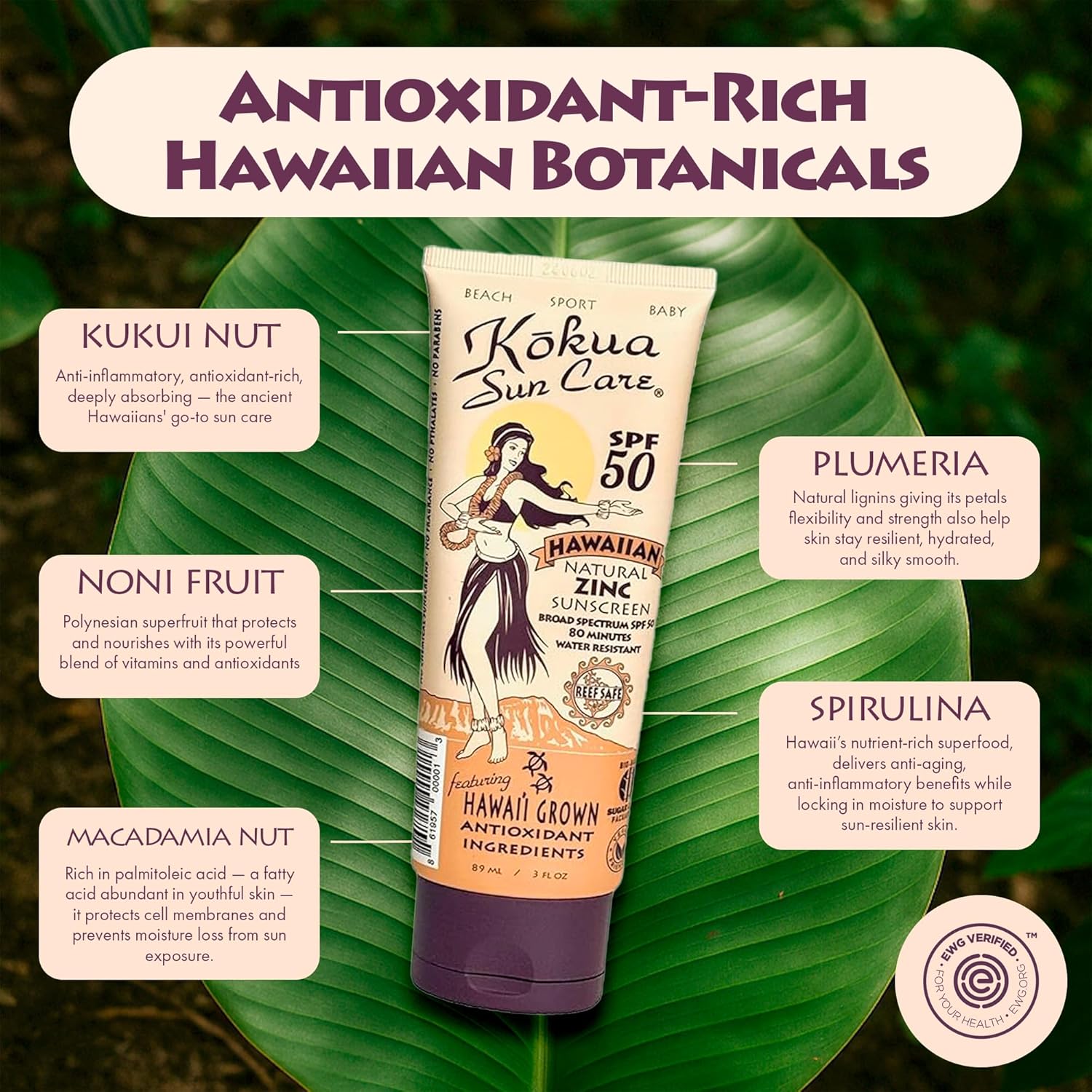
- Traveling to Palau? Cross-reference the active ingredients against all 10 banned substances. Mineral sunscreens (those using zinc oxide and/or titanium dioxide as the only active ingredients) automatically clear all three jurisdictions’ bans because they use no chemical UV filters at all.
- Buying for general reef-conscious use? Mineral-only formulations are the cleanest path through all current and anticipated restrictions.
The AAD’s published guidance on sunscreen notes that both zinc oxide and titanium dioxide are considered safe and effective by current regulatory standards, and that mineral sunscreens are a reliable option for people with sensitive skin or reef-safety concerns.
Mineral vs. Chemical: The Trade-off Stack
Knowing the law is step one. Knowing which mineral sunscreen is actually worth wearing is step two — because mineral sunscreens have historically carried real usability downsides that drove consumers toward chemical alternatives in the first place.
The honest mineral sunscreen trade-off:
| Factor | Mineral (Zinc/Titanium) | Chemical (Standard) |
|---|---|---|
| Reef compliance (all 3 jurisdictions) | ✓ Full | ✗ Partial to none |
| White cast on deeper skin tones | Historically significant | Minimal |
| Photostability (stays effective in sun) | High (zinc especially) | Variable by filter |
| Texture / wearability | Improving; still thicker | Lighter feel |
| Water resistance | Comparable; check label | Comparable |
The white-cast problem is the main friction point. Formulation has improved substantially: micronized and nano-particle zinc oxide disperses more transparently than older mineral formulas, and brands serving active-outdoor consumers have invested in tinted mineral options that neutralize the cast across a wider range of skin tones. EWG’s annual sunscreen guide, which rates hundreds of formulations against both safety and performance criteria, consistently highlights mineral-only products as the highest-scoring category for users prioritizing ingredient safety — including environmental safety.
For trail runners and open-water swimmers evaluating products like EltaMD UV Clear — a dermatologist-recommended mineral-based formulation — reviewers across aggregated skincare communities consistently note its non-comedogenic (pore-clogging-free) finish as a differentiator. Supergoop! has expanded its mineral-only lineup substantially, with products designed to address the texture complaints that have historically made mineral sunscreens less attractive to active-sport consumers.
What’s Coming Next — Jurisdictions to Watch
The legislative landscape is not static. Practitioners tracking this space should monitor:
- U.S. Virgin Islands — Has considered oxybenzone restrictions modeled on Hawaii’s law. No enacted legislation as of May 2026, but reef-protection advocacy groups have been active.
- Hawaiʻi expansion — Environmental advocates have pushed for Hawaii to expand its restricted-ingredient list toward Palau’s standard (adding octocrylene, homosalate). No expansion bill has passed as of this writing, but legislative sessions continue to surface proposals.
- Florida statewide action — Could go either direction: preempting Key West’s ordinance (a deregulatory move) or expanding restrictions across coastal municipalities (an expansion move). Both have active proponents.
- FDA GRASE monograph finalization — The FDA’s pending final rule on sunscreen active ingredients, long delayed, will determine the regulatory classification of several chemical UV filters on human-safety grounds. If octocrylene or homosalate receive unfavorable classifications, it would create commercial pressure that effectively aligns U.S. market availability with Palau’s environmental standard — without a reef-specific law requiring it.
EWG publishes annual updates to its sunscreen database and has been one of the more consistent sources tracking both the human-safety and environmental-safety dimensions of this regulatory story.
The Decision Rule
If you’re choosing a sunscreen for any reef-adjacent destination — or simply want a formulation that won’t need to be replaced as new jurisdictions enact restrictions — the decision rule is straightforward:
If the only active ingredients are zinc oxide and/or titanium dioxide, you’re compliant everywhere, now and under any foreseeable expansion of current law. No further label analysis required.
If you’re sticking with a chemical or combination formula:
- Hawaii / Key West only: Confirm the label shows no oxybenzone and no octinoxate. You’re legally clear.
- Palau: The full 10-ingredient checklist applies. Mineral-only is far easier than verifying each chemical filter.
- General future-proofing: Avoid octocrylene and homosalate even where they’re currently legal — both are on the watchlist of regulators and researchers, and the risk of buying a large supply of a formula that gets restricted mid-season is real.
The Skin Cancer Foundation’s published position is that reef-safe mineral sunscreens, applied properly (about one ounce for full-body coverage, reapplied every two hours), provide full broad-spectrum protection — meaning they block both UVA (the aging rays) and UVB (the burning rays). You’re not making a protection trade-off when you choose mineral. You’re making a formulation preference trade-off, and that gap has narrowed considerably as the category has matured.
The law is the floor. Mineral-only is the ceiling. For most reef-conscious buyers, those two points land in the same place.