If you’ve ever come off a long run to find your sunscreen pooled at your eyebrows — or arrived at the trailhead looking like you applied chalk — you already know the core problem: most everyday sunscreens were not designed for athletic output. Sunscreen is regulated in the United States as an over-the-counter drug product by the FDA. It works through one of two mechanisms: mineral filters (zinc oxide and titanium dioxide), which physically scatter UV rays off the skin surface, or chemical filters (avobenzone, octisalate, homosalate, and others), which absorb UV energy and convert it to heat. SPF — Sun Protection Factor — describes how much UVB radiation a product blocks under standardized lab conditions. The problem is that those lab conditions involve no sweat, no splashing, no windburn, and no three-hour alpine climb. This guide explains what “water resistant” legally means on a label, why each sport creates a distinct failure mode, and which formulations hold up when conditions are genuinely punishing.
If you’re a trail runner logging 40-mile weeks or an open-water swimmer doing weekday ocean sessions, you’re not choosing between “regular” and “sport.” You’re calibrating between filter chemistry, vehicle format (lotion, stick, gel, spray), and real-world reapplication constraints. Here’s how to make that call by sport.
What “Water Resistant” Actually Means — and What It Doesn’t
The FDA’s sunscreen monograph framework governs what every “sport” label is legally allowed to claim. Under the FDA’s proposed sunscreen rulemaking published in the Federal Register in 2019 and updated in 2021 proposed amendments, a product may claim “water resistant (40 minutes)” or “water resistant (80 minutes)” based on standardized immersion testing. Products cannot claim to be “waterproof” or “sweat-proof” — the FDA banned both terms from sunscreen labeling in 2011 as misleading.
What those ratings mean in practice: a product earned its rating from subjects doing moderate water immersion under controlled conditions — not vigorous exercise. Sweat, friction from clothing, toweling off, and heat-accelerated absorption are not part of that testing protocol. The number tells you about the floor, not the ceiling.
Key reference points across trusted sources:
- The American Academy of Dermatology, in its Sunscreen FAQs published at aad.org, recommends SPF 30 as a minimum for all outdoor activity and SPF 50 or higher for extended or high-UV-index exposure, with reapplication every two hours or immediately after heavy sweating or toweling — whichever comes first.
- The Skin Cancer Foundation, in its Sunscreens Explained resource at skincancer.org, notes that perspiration can meaningfully reduce effective SPF during vigorous activity, and recommends water-resistant formulas for any sport or exercise.
- Wirecutter, in its ongoing Best Sunscreen guide at wirecutter.com, consistently sets 80-minute water resistance as its baseline filter criterion when evaluating products for active outdoor use — a threshold that reflects the demands of real sport rather than the lab minimum.
For athletes, SPF 50 with an 80-minute water-resistance rating is the functional baseline. Everything below that is a compromise worth naming explicitly.
Trail Runners: Sweat Migration Is the Core Problem
The Failure Mode
Trail running creates a specific and predictable failure profile. You’re generating sustained, full-body sweat for 60 minutes to several hours. The face is the highest-stakes zone: sunscreen migrates from the forehead into the eyes, causing stinging that impairs vision, or simply runs off the cheeks during hard climbs. Wind at elevation accelerates evaporation and occludes the product film unevenly. And unlike a beach session, you cannot stop to reapply at mile 12 of a trail race.
Filter Chemistry for Runners
Chemical-filter sunscreens — avobenzone combined with octisalate, for example — absorb into the surface of the skin rather than sitting on top of it, which reduces migration under sweat. The tradeoff: chemical filters can sting on sensitive or compromised skin, and some filters including octinoxate and oxybenzone are restricted in reef-safe jurisdictions like Hawaii and Key West, which matters if your race calendar includes destination events. Runner’s World, in its Best Sunscreens for Runners guide at runnersworld.com, consistently identifies stinging at the eye line as the single most common complaint that eliminates an otherwise well-rated product from active use.
Mineral filters — zinc oxide and titanium dioxide — are reef-safe by default and non-irritating for most skin types, but traditional zinc-oxide formulas leave a white cast and can ball up under sweat. Newer micronized formulations have worked to close that gap. The EWG Guide to Sunscreens 2025, published at ewg.org, rates zinc oxide as the highest-safety active ingredient among sunscreen filters and continues to flag several common chemical filters for incomplete data on systemic absorption — a consideration for athletes applying product to large body surface areas across years of training.
Recommended Format Stack for Trail Runners
A stick formula for the face — which applies precisely without run-off during application and produces no excess liquid to migrate into eyes — paired with a lotion or cream for the body. Outside Online, in its Best Sunscreens for Every Outdoor Activity guide at outsideonline.com, and Runner’s World both consistently flag EltaMD UV Sport SPF 50 as a top performer for sweat resistance, citing its 80-minute water-resistance rating and no-sting-at-the-eyeline performance under hard effort. For mineral-committed runners, Thinksport SPF 50+ earns repeated mentions in the EWG Guide to Sunscreens 2025 for its zinc-oxide formula and streamlined ingredient deck.
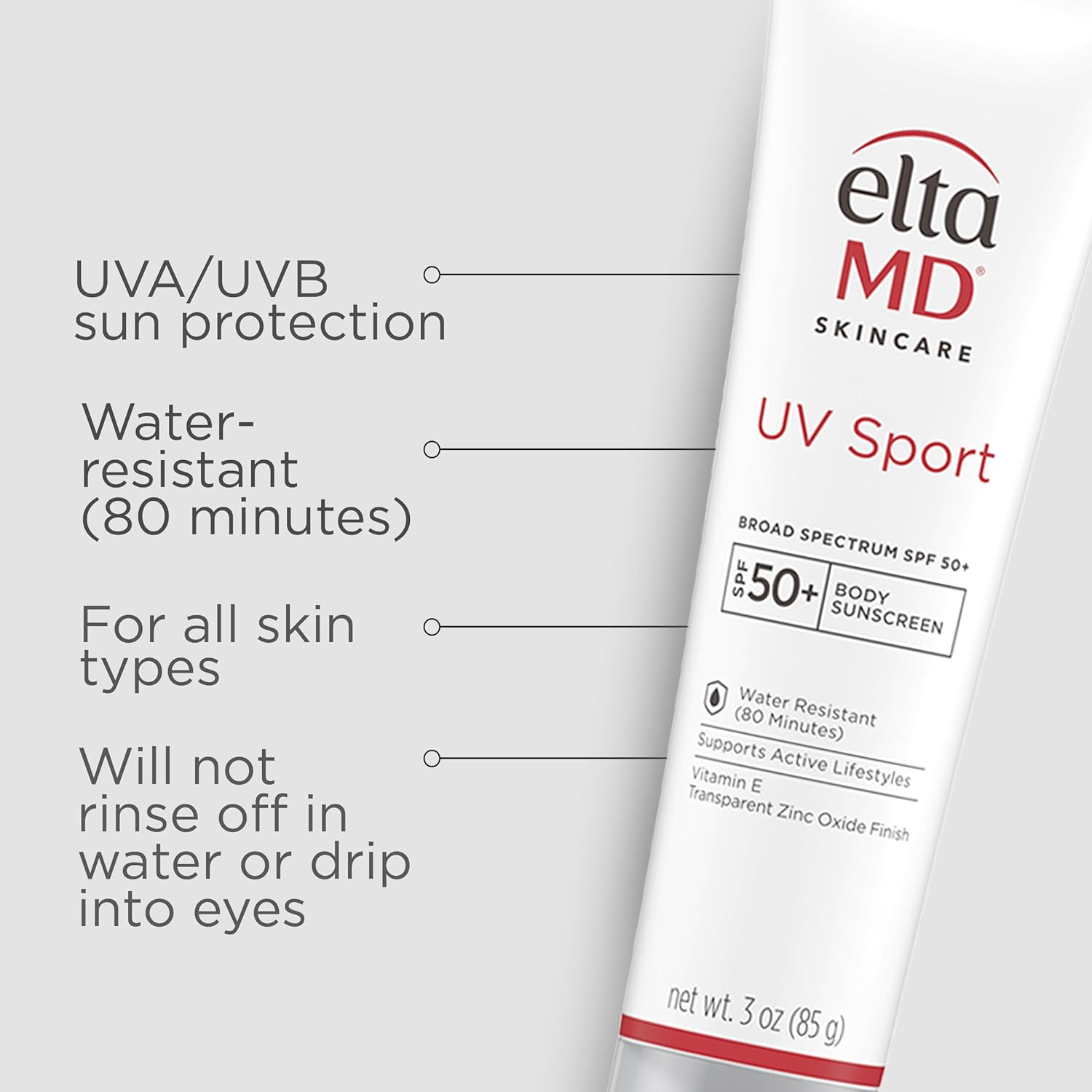
EltaMD
$27.20
In stock on Amazon
Check price on AmazonDecision rule: If your run is under 90 minutes and you have no reef-safe event requirements, an 80-minute–rated chemical-filter stick on the face plus lotion on the body delivers the lowest migration profile. If you’re mineral-committed or racing in Hawaii or Key West, allow 60–90 seconds of thorough blending — micronized zinc formulas have closed the white-cast gap significantly but still require real rubbing time to fully absorb, particularly on deeper skin tones.
Coppertone
$7.88
In stock on Amazon
Check price on AmazonCyclists: Wind Drying and Gear Contact Points
The Failure Mode
Cyclists share the sweat challenge with runners but add two variables that change the calculation. At 18–25 mph, convective drying causes sunscreen to evaporate faster from exposed skin. At the same time, helmet straps and eyewear frames create friction contact points that mechanically remove product — and leave unprotected lines on skin if you haven’t applied carefully around those contact zones before gear goes on.
The American Academy of Dermatology, in its Sunscreen FAQs at aad.org, recommends applying sunscreen 15 minutes before sun exposure and reapplying every two hours. For a four-hour century ride, that means carrying product and stopping — which most cyclists treat as a practical obstacle. This makes initial application quality, coverage thickness, and deliberate technique more important than in almost any other sport context.
Filter Chemistry and Format for Cyclists
Silicone-base serum formulas apply thin, dry down quickly, and resist mechanical transfer onto helmet padding better than creamy lotions. Byrdie, in its Best Sport Sunscreens guide at byrdie.com, highlights Supergoop Unseen Sunscreen for its near-invisible, serum-weight finish that holds up across longer face exposure without pilling under sweat or gear contact.
Spray formulas cover large surface areas — arms, legs, back of neck — quickly and are practical for pre-ride parking-lot application. However, the FDA has flagged inhalation as an area of concern with aerosol sunscreen products, and spray application in wind produces uneven coverage. The Skin Cancer Foundation, in Sunscreens Explained at skincancer.org, recommends applying spray to hands first and then rubbing onto skin — a step that meaningfully improves coverage uniformity even if it reduces some of the speed benefit.
Mineral stick formulas applied to the nose, cheekbones, and temples — the highest UV-exposure points on a cyclist’s face above the sunglasses line — remain the most mechanically durable option for those specific zones, even for cyclists who prefer chemical-filter products everywhere else.
Supergoop! SPF
$28.00
In stock on Amazon
Check price on AmazonDecision rule: For rides under three hours at moderate effort, a silicone-base chemical serum on the face plus SPF 50 lotion on exposed limbs plus a mineral stick on the nose and temples is the most practical application stack. For four-plus-hour efforts, build in one reapplication stop at the halfway fuel point. That single mid-ride reapplication is the most reliable way to maintain meaningful protection across a full day in the saddle.
Open-Water Swimmers: Full Immersion and Reef-Safe Compliance
The Failure Mode
Open-water swimmers face the most demanding sunscreen environment of any athletic category. Full immersion, saltwater or chlorine degradation of the product film, and the impossibility of mid-swim reapplication mean that initial application quality and formula durability are the only variables you can control. An 80-minute water-resistance rating is not optional here — a 40-minute rating will be functionally depleted before most open-water training swims end.
Two Considerations Unique to Swimmers
Reef-safe formulation requirements. If you swim in ocean environments covered by Hawaii Act 104, the Key West ordinance, or similar protections, oxybenzone and octinoxate are prohibited. This restricts the available chemical-filter palette and makes mineral formulas the practical default. Outside Online, in its Best Sunscreens for Every Outdoor Activity guide at outsideonline.com, and the EWG Guide to Sunscreens 2025 at ewg.org both identify Raw Elements SPF 30 Eco Stick and All Good Sport Mineral Sunscreen SPF 30 as ocean-swimming–tested mineral options with credible water-resistance performance. Raw Elements uses non-nano zinc oxide and carries reef-safe certification; field reviews note it applies thickly but holds through sustained open-water sessions without visible run-off.
Chlorine degradation. Pool swimmers face a different degradation vector — chlorine can break down certain chemical UV filters more rapidly than UV exposure alone. The pattern that emerges across competitive swim communities and Wirecutter’s Best Sunscreen coverage at wirecutter.com is a preference for higher-SPF mineral formulas applied 20–30 minutes before water entry to allow full film adhesion, rather than applying at the pool deck immediately before diving in.
EltaMD
$27.20
In stock on Amazon
Check price on AmazonDecision rule: Choose an 80-minute–rated mineral formula with non-nano zinc oxide for any ocean environment — for both durability and reef-safe compliance. Apply 20 minutes before entry. Cover behind the ears and the back of the neck, which face-up swimmers frequently miss. Reapply immediately upon exiting the water. For competitive pool swimmers, an 80-minute–rated SPF 50+ formula in stick form applied 20 minutes before warm-up is the practical optimum.
Sport-by-Sport Comparison: Which Formula Wins in Your Conditions
The three sport profiles translate into distinct purchasing decisions. The subsections below frame each as a standalone recommendation tier so you can skip directly to your sport.
Trail Running: Budget to Mid-Tier
For most trail runners, the best value entry point is an SPF 50 chemical-filter stick for the face paired with a body lotion — both carrying 80-minute water-resistance ratings. Thinksport SPF 50+ represents the mineral-committed budget option, earning consistent top marks from the EWG Guide to Sunscreens 2025 at ewg.org for ingredient safety and zinc-oxide concentration. EltaMD UV Sport SPF 50 occupies the mid-tier: a higher price point justified by its documented no-sting performance at the eyeline under sustained sweat, as noted by Runner’s World in its Best Sunscreens for Runners guide at runnersworld.com.
Coppertone
$7.88
In stock on Amazon
Check price on AmazonCycling: Mid-Tier to Premium
Cyclists investing in a multi-product application stack — serum face formula plus body lotion plus mineral nose stick — will find the per-ride cost higher than runners applying a single product. The silicone-serum category, led by options like Supergoop Unseen Sunscreen as highlighted by Byrdie in its Best Sport Sunscreens guide at byrdie.com, skews premium because the film-forming technology is more expensive to formulate than standard emulsion lotions. For cyclists not willing to run a three-product stack, a single high-SPF mineral lotion applied liberally and reapplied at the mid-ride fuel stop is an acceptable simplification — but does not fully solve the gear-contact-zone problem.
EltaMD
$27.20
In stock on Amazon
Check price on AmazonOpen-Water and Pool Swimming: Premium Mineral Formulas
Swimming demands the highest-durability formulas regardless of budget preference. The 80-minute immersion-tested mineral stick is the non-negotiable format: Raw Elements SPF 30 Eco Stick for ocean environments where reef-safe compliance is required, and an SPF 50+ mineral stick for chlorinated pool environments where degradation resistance is the primary concern. Both Outside Online at outsideonline.com and the EWG Guide to Sunscreens 2025 at ewg.org place non-nano zinc oxide mineral formulas at the top of their swimming-specific recommendations. The per-unit cost is higher, but the alternative — a depleted chemical-filter product mid-session with no opportunity to reapply — is not a cost savings in any meaningful sense.
Supergoop! SPF
$28.00
In stock on Amazon
Check price on AmazonThe through-line across every sport in this guide: no single formulation wins universally. The product decision is downstream of the sport’s specific failure mode. Identify whether your enemy is sweat migration, wind drying, full immersion, or chemical degradation — and the formulation choice follows logically from there.
SPF 50, 80-minute water resistance, and application 15–20 minutes before exposure are non-negotiables across every sport covered here. The American Academy of Dermatology at aad.org, the Skin Cancer Foundation at skincancer.org, and independent review sources including Wirecutter at wirecutter.com, Outside Online at outsideonline.com, Runner’s World at runnersworld.com, and EWG at ewg.org converge on those three parameters as the baseline for athletes. Everything else is calibration based on your specific sport, skin type, and event geography.