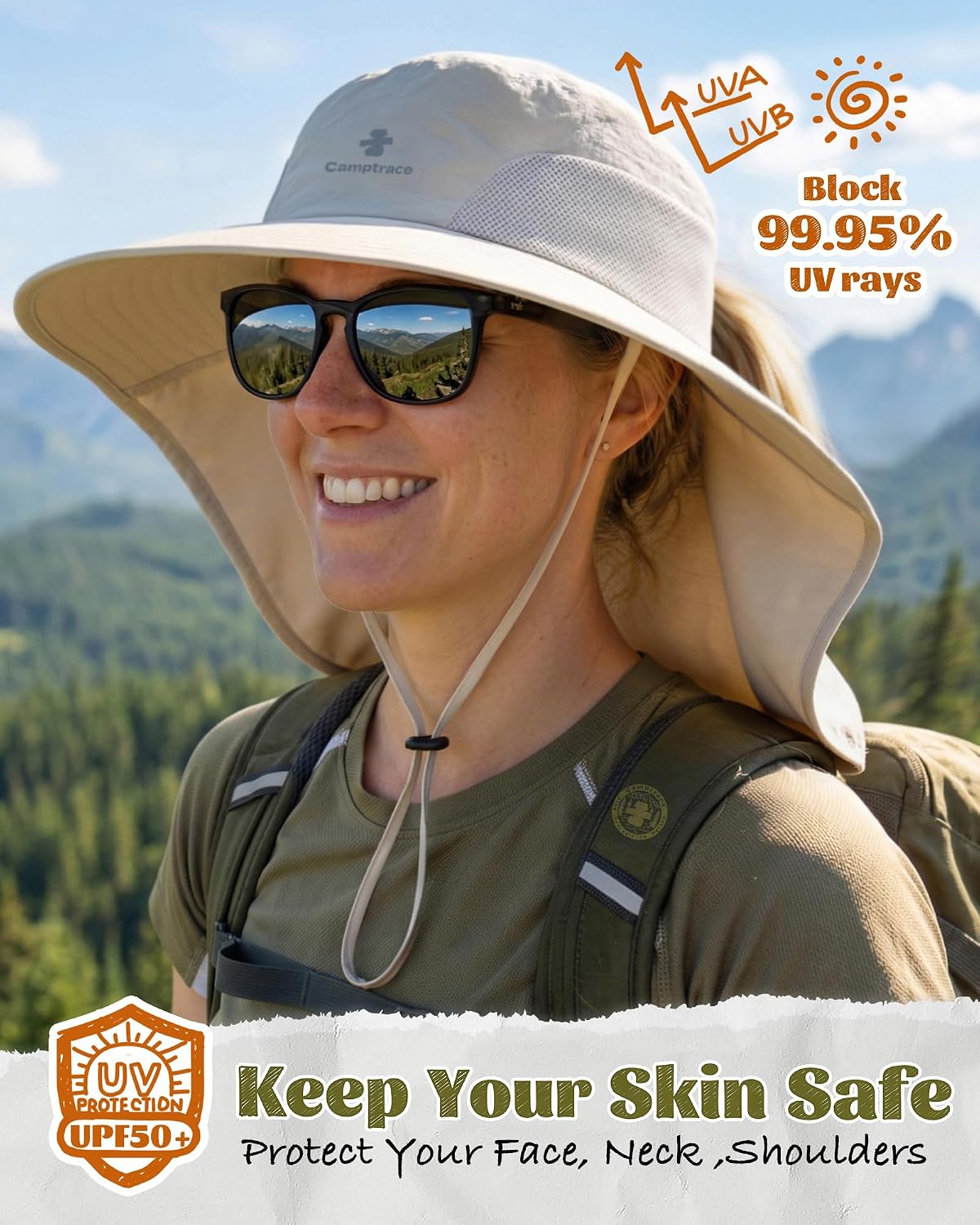
If you’ve ever finished a long day on the water or trail and noticed your neck and ears glowing red while the rest of you is fine, you already know the problem this article is about. Most sunscreens work well enough — but they wear off, rub off on pack straps, and get missed entirely in the spots behind your ears and along the back of your neck. A sun hat with a neck flap (sometimes called a legionnaire-style hat or a hat with a cape, baffle, or drape) solves this with fabric instead of chemistry. UPF — Ultraviolet Protection Factor — is the clothing equivalent of SPF: a UPF 50 fabric blocks roughly 98% of UV rays from reaching skin. The difference is that UPF-rated fabric doesn’t sweat off after two hours. This guide will help you understand exactly what to look for, where the real tradeoffs live, and which features are worth paying for versus which are marketing noise.
Why the Neck and Ears Are Your Highest-Risk Zones on Long Days Out
Dermatologists at the American Academy of Dermatology have long emphasized that the head, neck, and ears are among the most common sites for squamous cell carcinoma — one of the more serious forms of skin cancer — precisely because these areas accumulate lifetime UV exposure without the same cultural attention as the face. The Skin Cancer Foundation’s overview of sun-protective clothing notes that even a standard wide-brim hat leaves the back of the neck and ears largely unshielded once the sun angle drops below 45 degrees, which is exactly where it sits during early morning and late afternoon — peak hours for hikers and anglers.
The geometry matters. A 3-inch brim casts a useful shadow on the face and the tops of the shoulders, but it does almost nothing for the nape of the neck. A neck flap extends that protection down 4–7 inches of posterior neck and covers the ears in a way no hat brim alone can replicate. When you factor in that sunscreen reapplication every two hours is rarely happening on a 10-mile ridgeline or a five-hour float trip, the case for physical coverage over chemistry is straightforward.
Reviewers at Outside Online consistently point out that neck flaps have shed most of their “dorky fishing hat” stigma among trail runners and thru-hikers; the UPF hat market has matured enough that several brands now produce neck-flap designs with technical fabrics that double as active-sport performance gear.
The UPF Numbers That Actually Matter
Here’s a quick reference before we get into construction tradeoffs:
By the numbers:
- UPF 15–24 = good (blocks ~93–96% of UV)
- UPF 25–39 = very good (blocks ~96–97% of UV)
- UPF 40–50+ = excellent (blocks ~97.5–98%+ of UV)
- Standard cotton t-shirt wet = approx. UPF 3–5
The Skin Cancer Foundation certifies garments at UPF 30 and above. For a neck flap specifically, you want UPF 50+ because the fabric sits against the most UV-vulnerable skin on the back of your head and neck. Anything rated below 30 on a neck flap is a cosmetic feature, not a protective one.
One important nuance: UPF ratings are tested on dry, unstretched fabric. Brands including Coolibar publish wash-durability data alongside their UPF ratings — look for claims like “UPF 50+ after 50 wash cycles” rather than a bare UPF number. Moisture also temporarily degrades UPF in some synthetic blends; nylon-based fabrics generally maintain their rating when wet better than loosely woven polyester. Solbari’s technical documentation, for instance, specifies that their sun fabrics are tested wet as well as dry, which is a more rigorous standard worth asking about when comparing options.
Construction Tradeoffs: What to Evaluate Before You Buy
Not all neck flaps are built the same, and the differences show up exactly where you’ll feel them after four hours of wearing.
Attachment style: fixed vs. removable
Fixed neck flaps (stitched permanently to the hat) offer the highest UPF integrity because there are no gaps at the seam line between brim and flap. The tradeoff is packability and versatility — you can’t stuff the hat into a hip belt pocket without the flap adding bulk. Removable flaps (usually velcro or snap attachments) let you convert the hat for town or cooler conditions, but reviewers on Backpacker’s gear guides note that velcro attachment points can leave small UV gaps at the junction if the flap is misaligned. For dedicated sun protection on water or above treeline, fixed wins. For a hat you’re also wearing to the trailhead parking lot, removable is a reasonable compromise.
Flap length and ear coverage geometry
A 4-inch flap covers the nape of the neck adequately for most sun angles. A 6–7-inch flap adds protection to the upper shoulders — useful for open-water swimmers and kayakers where reflected UV off the water adds a second UV source from below. The ear coverage cutout is the detail most buyers miss: look for a hat where the flap wraps forward enough to shade the entire ear, not just the earlobe. Anglers who spend hours looking down at the water are particularly vulnerable at the ear-to-cheek junction, and that gap is where many designs fall short.
Fabric weight and cooling performance
The UPF conflict most buyers hit is this: dense weaves protect better but trap heat. Brands solve this differently. Coolibar uses a tightly woven stretch nylon with built-in wicking and their Suntect fabric technology, achieving UPF 50+ while remaining breathable enough for trail use. Patagonia’s Quandary sun hat uses a ripstop nylon that prioritizes packability. Solbari leans into a fine polyester microweave they describe as “cool-touch” in their product specifications. None of these are lab claims the site can verify independently — but across aggregated buyer reviews on major outdoor retail platforms, the pattern is consistent: Coolibar buyers report comfort in sustained heat better than stiffer nylon options, while Patagonia buyers favor the pack-flat convenience.
Mesh-panel designs can feel cooler but almost always sacrifice UPF at the mesh zones. A hat rated UPF 50+ overall may have neck flap mesh rated only UPF 15. Always check whether the UPF rating applies uniformly to the flap or just to the crown panel.
Brim width paired with the flap
A neck flap doesn’t eliminate the need for brim coverage — it complements it. The ideal pairing for hiking and fishing is a 3–4 inch all-around brim with a full neck flap, covering the face-to-neck transition where a narrow brim leaves the cheekbones and temples exposed. Wide-brim hats (4+ inches) start to catch wind on exposed ridges and interfere with pack straps or fishing rod handling. The 3-inch brim is the practical sweet spot confirmed by trail testers at Backpacker and by fishing-specific reviewers who note that ultra-wide brims restrict peripheral vision when scanning the water.
Decision Framework: Matching Hat to Activity
This is where the choice compresses into actionable rules.
If you’re a day hiker or thru-hiker on exposed routes: Prioritize packability and a fixed flap. A lightweight nylon hat that stuffs to fist-size and deploys in a second is more likely to actually get worn when conditions change than a stiff canvas alternative. Look for UPF 50+ on both crown and flap, a 3-inch brim, and built-in sweatband or moisture-wicking headband. Coolibar’s Shapeable Sun Hat and Sunday Afternoons’ Ultra Adventure hat are both frequently cited in Outside Online’s round-ups as strong options in this category.
If you’re a freshwater or saltwater angler: Reflected UV off water can double your effective UV exposure — the Skin Cancer Foundation notes that water reflects up to 25% of UV radiation back at the angler from below. This means you want UPF 50+ on every panel, a flap long enough to reach the upper shoulder, and serious ear coverage that wraps forward. A fixed flap with no velcro gaps is the right call. Ventilation is secondary to coverage here; anglers who want cooling can pair a UPF hat with a UPF neck gaiter to fill any remaining gaps.
If you’re a weekend hiker or casual outdoor user: A removable flap gives you the flexibility to wear the hat socially without looking like you’re about to ford a river. The UPF tradeoff at attachment seams is acceptable for intermittent use. Budget options in the $25–$45 range from brands like Outdoor Research perform reasonably here — look for an ASTM or AS/NZS 4399 certification label, which is the standard the Skin Cancer Foundation uses for its seal of approval, rather than relying on unverified marketing claims.
If you’re an open-water swimmer or paddle-sport athlete: You need a hat that stays on in wind and water — chin strap is non-negotiable. Look for a design with a snorkel-cord or wide-weave chin strap, a flap rated UPF 50+ when wet, and a hydrophobic or quick-dry outer fabric. This is the one use case where a slightly longer flap (6–7 inches) is worth the added bulk.
Price and Value: What the Tiers Actually Get You
| Price tier | What you’re paying for | What you’re giving up |
|---|---|---|
| $20–$35 | Certified UPF 50+, basic construction | Durability, fit refinement, cooling fabric tech |
| $40–$65 | Better fabrics, wash-durable ratings, packability | Premium brand longevity guarantees |
| $70–$120+ | Technical fabric systems, brand UV warranty, superior fit | Budget |
The Skin Cancer Foundation’s guidance is clear: a certified UPF 50+ garment at any price point delivers the same UV protection as a premium one. The difference above $65 is real but isn’t UV protection — it’s fabric longevity, fit quality, and cooling performance. For someone buying a single hat to use twice a month, a $30 certified hat from a reputable outdoor brand is defensible. For a guide, commercial fisher, or construction worker logging 200+ days of direct sun annually, the per-use cost math strongly favors a $90 hat that holds its UPF rating through 50+ washes over one that degrades after a season.
The Bottom Line
The case for a sun hat with a neck flap isn’t complicated: your neck and ears are high-risk zones that sunscreen consistently fails to protect in real-world conditions, and fabric protection doesn’t wear off. The decision complexity is in the details — fixed versus removable flap, UPF uniformity across all panels, brim width, and whether wet-fabric UPF is documented. If you’re choosing one piece of sun-protective gear to prioritize this season, a UPF 50+ hat with a fixed, full neck flap delivers more consistent protection per hour outdoors than any sunscreen application strategy alone — and it compounds over a lifetime of use.