If you’ve ever stepped outside wearing sunscreen and foundation layered on top of each other, you already know the problem: two products, fifteen minutes, and you’re still not sure which one you applied first. Tinted mineral sunscreens are designed to collapse that stack into a single step. “Mineral” means the active ingredients are physical UV-blockers — zinc oxide and/or titanium dioxide — that sit on the surface of your skin and reflect UV rays away rather than absorbing them chemically. “Tinted” means pigment has been blended in to match a range of skin tones, which solves the notorious white-cast problem that kept many people away from mineral formulas for years. At SPF 50, you’re blocking roughly 98% of UVB rays (the burn-causing wavelength) — enough to satisfy dermatologist recommendations for daily use. What this article will give you: a clear framework for deciding whether a tinted mineral SPF 50 can actually replace your foundation, which formulas are worth the $30–$70 price tag, and how to match product choice to your specific use case.
Why “Mineral” Still Matters in 2026 — and Why Tint Changed the Game
Let’s start with the honest trade-off that practitioners in the photoprotection space already know: pure mineral sunscreens have an ingredient-safety advantage and a cosmetic disadvantage, and tint is what finally closed that gap.
The safety case for mineral actives is well-established. The American Academy of Dermatology’s Sunscreen FAQ notes that zinc oxide and titanium dioxide are the only two active ingredients currently classified as GRASE (Generally Recognized as Safe and Effective) under the FDA’s 2019 proposed sunscreen monograph update. Chemical UV filters including oxybenzone, octinoxate, and octisalate are still under review pending additional safety data. For sensitive skin, reef-safe compliance (required in Hawaii, Key West, and Palau, with several additional jurisdictions adding restrictions through 2025–2026), and pediatric use, mineral is the default recommendation from most dermatologists.
The white-cast problem was the long-standing friction point. High concentrations of zinc oxide scatter visible light, leaving a chalky residue that photographs badly, reads as ashy on medium-to-deep skin tones, and simply looks unfinished. Tinted formulas address this in two ways: (1) iron oxide pigments neutralize the inherent white of zinc, and (2) those same iron oxides provide meaningful protection against visible light and HEV (high-energy visible, or “blue light”), which standard SPF ratings don’t measure at all. Allure’s explainer on mineral vs. chemical sunscreens notes that iron oxide tints are increasingly cited by dermatologists as a bonus benefit for patients with melasma or hyperpigmentation, since visible light can trigger pigmentation flares even when UVA/UVB is fully blocked.
The net result: a well-formulated tinted mineral SPF 50 gives you UV protection, visible-light defense, tone-correction, and skin-evening coverage in one application. That’s a genuine functional upgrade over an untinted mineral formula — not just a cosmetic add-on.
The Decision Frame: When Tinted Mineral SPF Actually Replaces Foundation
This is the question that separates a useful purchase from a regret. The honest answer is “it depends on your coverage expectations,” and here’s how to map that cleanly.
It works as a foundation replacement if:
- You want light-to-medium coverage (think: skin-evening, not full concealment)
- Your primary skin concerns are redness, mild discoloration, or uneven tone — not textural issues requiring concealer-level coverage
- You’re active outdoors (trail running, cycling, open-water swimming) and want to minimize product layers that will migrate
- You’re already using a separate color-correcting concealer for targeted spots and just need a base
It won’t replace foundation if:
- You rely on foundation for significant coverage of acne, rosacea flares, or deep hyperpigmentation
- You need buildable, blendable coverage that stays matte through a full workday in a climate-controlled office
- Your current routine involves setting powder or a blurring primer, both of which work better over a dedicated foundation formula
The Skin Cancer Foundation’s Sunscreens Explained resource emphasizes that application thickness matters: most people apply sunscreen at roughly 25–50% of the dose used in SPF lab testing, which means real-world SPF protection is often lower than the label number. With a tinted formula doubling as coverage, there’s even more temptation to apply a thin, beauty-motivated layer. Practitioner-level habit: apply tinted mineral SPF the way you’d apply sunscreen, not the way you’d apply foundation — which generally means a bit more product than feels intuitive.
By the Numbers
| SPF Level | UVB Rays Blocked | Reapplication Window (ideal conditions) |
|---|---|---|
| SPF 30 | ~97% | Every 2 hours / after swimming or sweating |
| SPF 50 | ~98% | Every 2 hours / after swimming or sweating |
| SPF 50+ (broad-spectrum) | 98%+ UVB + meaningful UVA | Same — no formula eliminates reapplication need |
The jump from SPF 30 to SPF 50 is real but modest — roughly one percentage point of additional UVB blockage. Where SPF 50 earns its keep is in the gap between ideal lab application and real-world thin application: when you’re running light, the higher-rated formula gives you more of a buffer.
The Formulas Worth Knowing (and the Trade-offs They Each Make)
Based on aggregated review patterns across Byrdie’s 2025 tinted sunscreen roundup, Wirecutter’s sunscreen coverage, and the EWG’s 2025 Guide to Sunscreens, a consistent set of formulas surfaces across skin-tone and use-case segments. Here’s how they sort by the decisions that matter.
EltaMD UV Elements Tinted ($45, broad-spectrum SPF 44) Reviewers across multiple dermatology-adjacent platforms consistently rate this as the go-to for sensitive, redness-prone, and post-procedure skin. The active blend is 9% zinc oxide + 7% titanium dioxide — a higher titanium ratio than most, which contributes to the light finish. The coverage is sheer-to-light; owners frequently describe it as “your skin but better” rather than a coverage product. The single tint shade limits its range — it works well for light-to-medium skin tones, less well for deeper ones. Note the SPF 44 rating: still strong protection, but worth knowing if SPF 50 is a hard requirement.
Supergoop! CC Screen SPF 50 ($38) This is probably the most coverage-forward option in the tinted-mineral-meets-foundation category. Byrdie’s roundup consistently positions it as a true CC cream (color-correcting cream) rather than a sunscreen with a tint, and owner reviews support that framing: users describe it as buildable and blendable in a way that most SPF-first formulas are not. The 100% mineral formula comes in a wide shade range (14 shades as of the current lineup), which is a meaningful differentiator for medium and deeper skin tones. Trade-off: the richer texture means it reads more like a beauty product, which can encourage under-application. Practitioner note: if you’re recommending this to an outdoor-sport context, add the reapplication reminder emphatically.
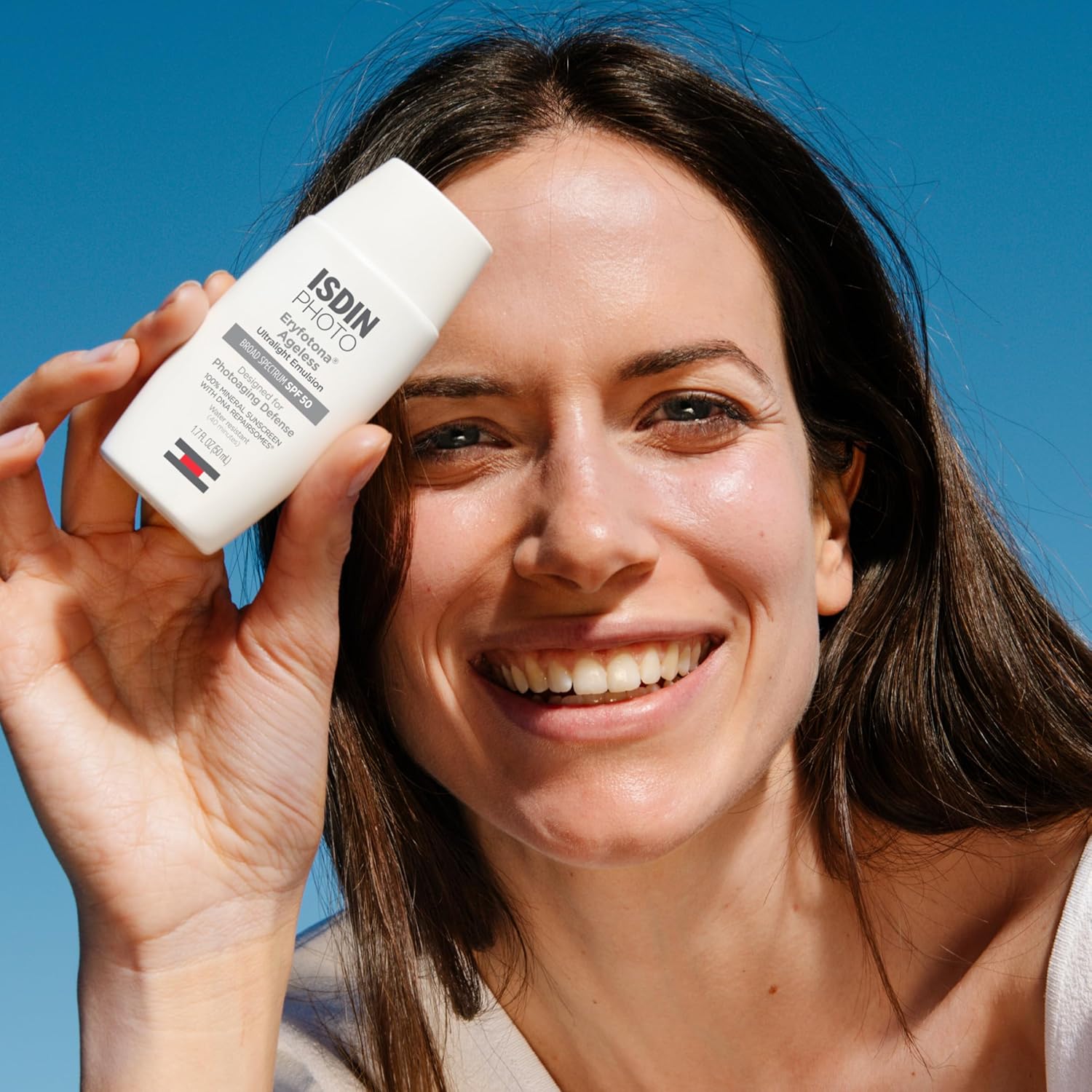
ISDIN Eryfotona Ageless Tinted SPF 50 ($70) This is the premium-tier option and it earns the price point through formulation depth. The active is 10.9% zinc oxide — on the higher end for a tinted formula — and the product adds Fernblock (a proprietary standardized extract of Polypodium leucotomos, a fern extract with published photoprotective research) and DNA repairosomes. EWG’s 2025 guide rates the Eryfotona line favorably for ingredient transparency. Coverage is light-to-medium with a luminous finish; it’s particularly well-reviewed for mature skin types where a dewy result reads more naturally than a matte one. At $70, it’s positioned squarely in the serious-photoprotection buyer segment — the same audience already spending on Coolibar UPF apparel treats this as a face-level complement to a full sun-protection system.
Black Girl Sunscreen Make It Glow SPF 30 Moisturizing Sunscreen (Tinted, ~$16) Worth naming explicitly because the tinted mineral market has historically underserved deep skin tones, and this formula was specifically developed to address that gap. SPF 30 rather than 50, and chemical actives rather than purely mineral — but it sits in the tinted-protection conversation because it was designed from the ground up for brown and deep skin tones that most tinted SPF formulas still map poorly. If SPF 50 and purely mineral actives are required (reef-safety compliance, sensitivity), this isn’t the match. If the priority is tone accuracy and wear comfort for deeper skin tones with an understanding of the SPF 30 trade-off, it’s a meaningful option.
The If/Then Decision Rules
You’ve been building toward this, so here it is, structured:
If your skin is light-to-medium, sensitive or redness-prone, and you want the cleanest possible ingredient profile → EltaMD UV Elements Tinted is the most defensible pick. Accept the single-shade limitation and the SPF 44 (not 50) rating.
If you want the closest thing to a true foundation replacement with shade-matching options → Supergoop! CC Screen SPF 50. Budget for a slightly heavier texture and be intentional about application volume.
If you’re a serious photoprotection buyer already thinking systemically about sun damage (post-procedure, melasma management, long-term anti-aging protocol) → ISDIN Eryfotona Ageless at $70 is the formula that matches the investment level. The added DNA-repair actives are a differentiator worth paying for at this use-case.
If tinted mineral SPF is a barrier because your skin tone isn’t represented → Don’t force a poor shade match just to check the “mineral” box. A well-formulated broad-spectrum SPF 50 chemical sunscreen used consistently will outperform a poorly-matched mineral formula applied reluctantly and sparingly.
If your use case is outdoor sport (trail running, open-water swimming, cycling) → Prioritize water resistance (80-minute rating) and reapplication discipline over cosmetic finish. Most tinted formulas in this category are not water-resistant; plan for a mineral sport formula on top or a dedicated reapplication product.
The broader lesson: tinted mineral SPF 50 is a genuinely useful product category that solves a real workflow problem — but only if you apply it in the quantity that delivers the protection the label promises. The cosmetic job doesn’t substitute for the sunscreen job. When both jobs are done right, it’s one of the most efficient purchases in a thoughtful sun-protection routine.