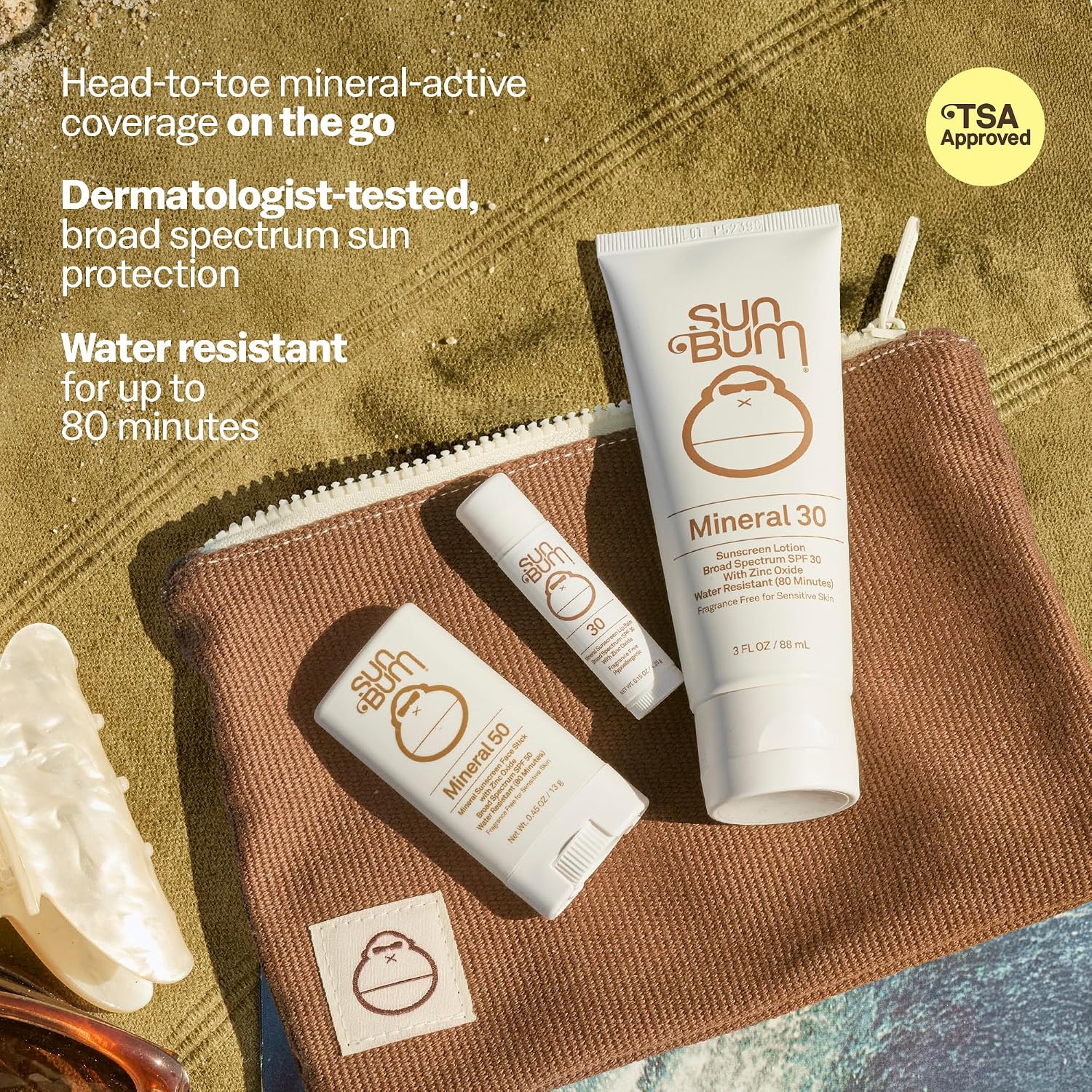
If you’re heading somewhere with turquoise water and a coral reef beneath it, there’s a good chance the destination has — or is moving toward — rules about what sunscreen you can wear in the water. “Reef-safe” means a sunscreen is formulated without the chemical UV filters (the active ingredients that absorb UV light) that research has linked to coral bleaching and reef toxicity; the most scrutinized are oxybenzone and octinoxate. The alternative is a mineral sunscreen, which uses zinc oxide or titanium dioxide — physical minerals that sit on the skin and deflect UV light rather than absorb it. On top of that destination-side constraint, you’re also dealing with the TSA’s 3-1-1 carry-on rule: each liquid container must be 3.4 oz (100 mL) or smaller, all containers must fit in a single quart-sized clear bag, and one bag per person is the limit. This guide walks you through exactly how to build a kit that satisfies both requirements — right formula, right size, right pack — without paying $70 for something that gets confiscated at the checkpoint.
Why the Formula Constraint Is the Harder Problem
Most travelers treat the TSA rule as the main obstacle. It isn’t, once you understand the framework. Travel-size containers are widely available; plenty of premium mineral sunscreens now ship in 1 oz and 3 oz formats purpose-built for this use case. The trickier variable is which active ingredients are actually prohibited at your destination — and that list is evolving faster than most product labels.
The current legal landscape, as of mid-2026:
| Destination | Key Prohibited Filters | Effective Since |
|---|---|---|
| Hawaii (state waters) | Oxybenzone, octinoxate | Jan 1, 2023 |
| Key West, FL | Oxybenzone, octinoxate | Jan 1, 2023 |
| Palau | 10 specific chemical filters incl. oxybenzone, octinoxate, octocrylene | 2020 |
| U.S. Virgin Islands | Oxybenzone, octinoxate | 2020 |
| Bonaire | Oxybenzone, octinoxate | 2021 |
Palau’s Responsible Tourism Education Act is the strictest framework currently in effect anywhere — it bans 10 filters total, including octocrylene, which still appears in several sunscreens marketed as “reef-safe.” Per the Skin Cancer Foundation’s overview of mineral vs. chemical sunscreen options, the only UV filters that clear all current destination bans are zinc oxide and titanium dioxide used as the sole active ingredients. If a label says “reef-friendly” but still lists avobenzone, homosalate, or octocrylene in the active ingredients panel, it will not be legal in Palau or certain European marine protected areas beginning to adopt similar standards.
The practical takeaway: ignore marketing language on the front of the bottle. Flip it over, read the Drug Facts active ingredients panel, and confirm you’re looking at zinc oxide and/or titanium dioxide only — no other actives listed.
Building Your 3-1-1-Compliant Mineral Kit
Once the formula constraint is solved, the logistics become a straightforward optimization. Here’s the decision framework:
Step 1: Calculate your coverage needs, then work backward to container count.
A standard rule of thumb from the American Academy of Dermatology (AAD’s sunscreen application guidelines) is one ounce — roughly a shot glass — to cover an adult body for one application. A 3.4 oz bottle gets you about three full-body applications. For a five-day beach trip with daily reapplication every two hours, you need far more product than one carry-on bag can legally hold. The honest answer for any trip longer than three days: check a larger bottle, or buy a full-size locally. The carry-on kit is your first-day and in-flight coverage, not your entire trip supply.
Step 2: Prioritize face sunscreen in the carry-on.
Face sunscreens are higher-margin, harder to find in local drugstores at destination, and the one application you realistically can’t skip even in transit. A 1–1.7 oz face sunscreen occupies minimal bag space and protects the area most critical for daily SPF compliance. This is where spending up makes sense.
Step 3: Add a lip-specific SPF and consider a dry-touch or tinted option.
Lips have no melanin and burn faster than facial skin. An SPF 30–50 lip balm takes essentially no bag space and covers a real gap. If you wear any complexion product, a tinted zinc oxide formula (which doubles as a light-coverage tint) can replace a separate step.
Step 4: Fill remaining bag volume with body coverage, sticks, or a travel tube.
Mineral sunscreen sticks — solid format, no TSA liquid count — are technically not subject to the 3-1-1 rule, though TSA agents may flag sticks above a certain size for inspection. Sunscreen sticks of 0.5–1 oz are reliably waved through. Sticks are especially practical for reapplying around the eyes, on ears, and on the back of hands without needing clean dry skin.
Products Worth Considering Across the Price Spectrum
Note: All assessments here are based on published formulations, brand-disclosed ingredient lists, and aggregated owner and reviewer feedback. No product was physically evaluated by this publication.
Face (the anchor of any reef-safe travel kit):
EltaMD UV Clear Broad-Spectrum SPF 46 is the mineral face sunscreen most consistently recommended by dermatologists, per the AAD’s consumer guidance and EWG’s 2025 Sunscreen Guide, which gives its zinc oxide active a top safety rating. The 1.7 oz travel size is purpose-built for carry-on use. Owners across aggregated reviews consistently note the non-greasy finish and compatibility with acne-prone or sensitive skin. The active is 9% transparent zinc oxide — compliant with all current destination bans. List price for the 1.7 oz format runs approximately $32–$36, making it the mid-tier face option with strong dermatologist backing.
Supergoop! Unseen Sunscreen SPF 40 — important caveat here. Despite its viral reputation and excellent texture, Unseen Sunscreen uses chemical UV filters (octisalate, homosalate) and is not compliant with Hawaii, Palau, or Key West restrictions. It is relevant to this guide only as a counterexample: it won’t clear destination-side reef-protection laws regardless of how it performs otherwise. If Supergoop! is your current go-to, the brand’s Zincscreen 100% Mineral Lotion SPF 40 is the reef-legal swap — same brand, different formula.
Body and general coverage:
Blue Lizard Sensitive Mineral Sunscreen SPF 50+ frequently appears in dermatology-adjacent coverage (the EWG 2025 Sunscreen Guide lists it favorably) and is formulated with zinc oxide and titanium dioxide only — no chemical filter actives. Travel-size 3 oz tubes fit the carry-on rule and retail in the $12–$16 range, making it the most accessible price point for reef-compliant body coverage without sacrificing SPF performance.
Thinksport SPF 50+ Mineral Sunscreen is a frequent recommendation in Outside Online’s outdoor sunscreen roundups and is certified by the Leaping Bunny program. It uses 20% zinc oxide as the sole active. Owners in longer-format reviews describe it as thick on application but notes that it blends adequately for outdoor use. The 3 oz size is TSA-legal.
Stick format (TSA liquid-rule bypass):
Babo Botanicals Clear Zinc Sunscreen Stick SPF 30 is a solid-format option. As a stick, it doesn’t count toward your 3-1-1 bag allotment. Published formulation lists zinc oxide as the sole active. Reviewers note it’s particularly practical for children’s faces and for reapplication on ears and nose without the mess of lotion. At roughly $14–$18 per stick, it’s a low-cost add to any kit.
Premium option for serious sun-safety travelers:
Colorescience Sunforgettable Total Protection Brush-On Shield SPF 50 is a powder mineral sunscreen in a brush applicator — also not subject to TSA liquid rules. Published specs list titanium dioxide and zinc oxide as the active ingredients. Byrdie’s and Allure’s coverage of mineral makeup-sunscreen hybrids consistently highlight it as the gold standard for reapplication over makeup. It runs $65–$70, which is steep, but owners report a single brush lasting four to six months with daily use, and the reapplication convenience during a travel day is legitimately different from any lotion format.
The Destination-Purchase Strategy: When Not to Pack It All
For trips longer than four days, the math on carry-on-only sunscreen rarely works. A full-body SPF 50 application is roughly 1 oz; reapplied every two hours during six hours of sun exposure, that’s three applications or ~3 oz per day for an adult. A three-day supply for one person already fills the entire quart bag.
The smarter strategy for week-plus trips: carry the face sunscreen and the stick in your personal item (the face product is the hardest to source locally at a fair price and the right formula), and plan to purchase body coverage at your destination.
Two caveats: (1) Verify that local pharmacies or reef-compliant retailers actually stock mineral-only sunscreen before you assume you’ll find it. In smaller Caribbean island destinations, mineral-only options can be limited to resort gift shops at significant markup. (2) If you’re traveling to Palau specifically, the destination actively enforces the sunscreen ban — enforcement rangers can and do check products — so don’t assume you’ll figure it out on arrival.
EWG’s 2025 Sunscreen Guide maintains a searchable database of products by active ingredient, which is the fastest way to verify any specific product’s compliance before you pack it.
The Decision Rule
If you’re flying carry-on only to a reef-protected destination for 3 days or fewer: pack a full 3-1-1 kit — zinc-oxide-only face sunscreen (1–1.7 oz), a mineral body lotion (3 oz), a stick, and an SPF lip balm. You can cover yourself adequately and legally within the bag limit.
If you’re checking a bag: bring a full-size mineral body sunscreen in checked luggage, carry only the face product and stick in your personal item, and don’t waste quart-bag space on body lotion.
If your trip is longer than five days or involves multiple adults: plan to supplement with a local purchase, confirm availability in advance, and use the EWG database or the destination’s tourism authority site to verify which specific products are approved before you travel.
If a product’s front label says “reef-safe” but the active ingredients panel includes anything beyond zinc oxide and/or titanium dioxide: it will not be legal in Hawaii, Palau, Key West, or the U.S. Virgin Islands. The marketing claim means nothing; the Drug Facts panel is the deciding document.
The kit that clears security and stays legal at your destination isn’t complicated — it’s just a formula question dressed up as a logistics question. Solve the formula first; the packing follows naturally.